
Temporary File Hosting
Temporary file hosting is file sharing where deletion is the default rather than something you remember to do. The service removes your upload automatically — after a fixed number of days, after a single download, or once nobody has touched it for a while. You give up the guarantee that a link still works next month, and in exchange nothing is left lying around.
Three different meanings of "temporary"
Services in this category are lumped together but behave very differently, and picking the wrong expiry model is the usual reason a transfer fails.
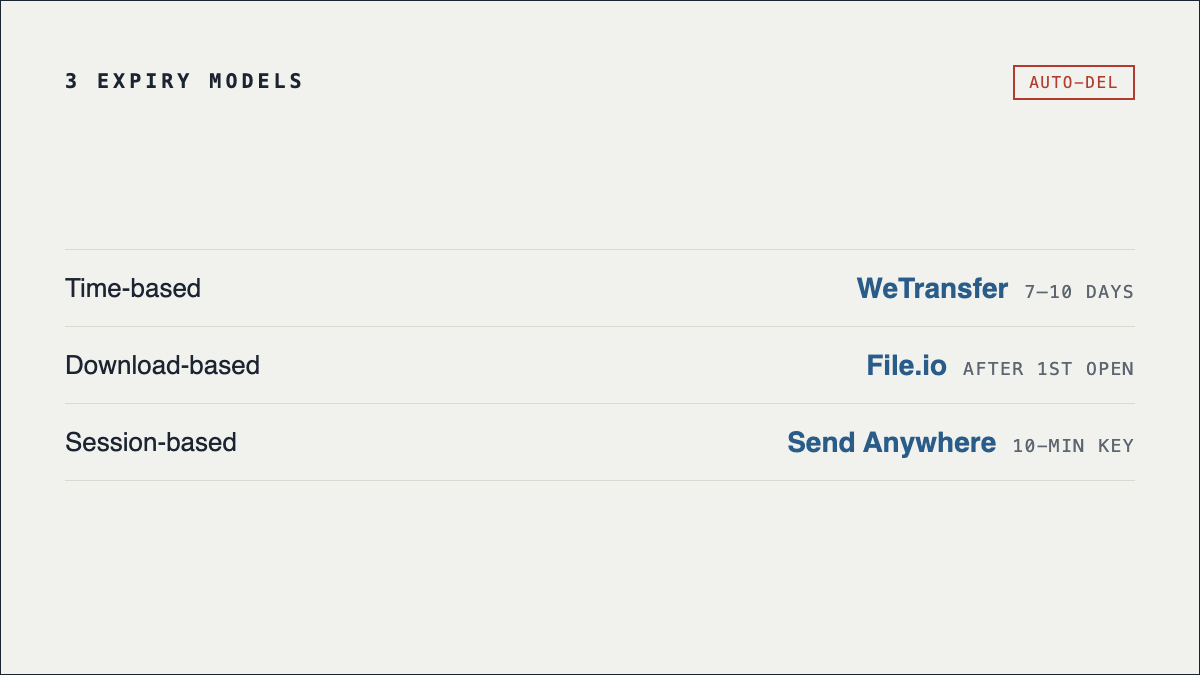
- Fixed clock. The file dies on a schedule regardless of use — WeTransfer's 3 days. Predictable, and the easiest to explain to a recipient.
- One download. The file is destroyed the moment it is fetched, as File.io does. Strongest for something sensitive, and the most fragile: a mail scanner or a preview fetcher can consume the single download before your recipient ever clicks.
- Inactivity. The file lives as long as people keep downloading it and is reclaimed when they stop, which is Gofile's model. Good for a file several people will pull over weeks, bad if you need a guarantee.
Free options compared
| Service | Free limit | Deletion model | The catch |
|---|---|---|---|
| Send Anywhere | Unlimited, device to device | Key expires in 10 minutes | The uncapped size applies to the direct peer-to-peer mode. Link-based transfers are capped. |
| Gofile | 20 GB per file | Kept while downloaded, removed when inactive | Free downloads are throttled and every download page carries ads. Password protection is paid. |
| WeTransfer | 3 GB per transfer | 3 days | Free use is capped at 10 transfers OR 3 GB total per 30 days, whichever comes first. |
| File.io | Small files | Deleted after one download | Genuinely one-shot. If the recipient opens the link twice, the second attempt fails. |
Figures last verified 24 September 2026.
When to use it, and when not to
Temporary hosting suits a handover: a file that exists to get from you to one other person and has no reason to outlive that. Sending a designer a source file, passing a scan to an accountant, getting a video off a phone and onto a laptop. Nothing to sign up for, nothing to tidy up after.
It is the wrong tool whenever the link needs to keep working. Do not use it for anything you will publish, reference from a document, or send to a group who will get to it at their own pace — the file will quietly vanish and you will not be told. For that, use cloud storage with a stable share link. And never treat a temporary host as a backup: it is the one category of service explicitly designed to lose your file.
Auto-delete is not privacy
A file that deletes itself after three days was still readable by the provider for three days. Expiry reduces the window of exposure; it does not close it. If the contents genuinely matter, encrypt the file before uploading and send the password separately — that way the deletion timer is a convenience rather than your only protection. See no sign-up file sharing for why skipping registration does not make a transfer anonymous either.
Frequently asked questions
Can I recover a file after it expires?
No. Deletion is the product. Keep your own copy — the uploaded file is a delivery mechanism, not storage.
Which lasts longest on a free plan?
Gofile, because it keeps files that are still being downloaded instead of running a fixed clock. It offers no guarantee, though — an unused file is removed.
Was Megaupload temporary hosting?
No, it was the opposite: files stayed until you removed them, which is partly why so much accumulated there before the 2012 seizure. The full history explains what happened to all of it.
megaupload.nz is an unofficial fan recreation of the pre-2012 interface and is not affiliated with Kim Dotcom, Megaupload Limited, or Mega Limited. No service listed here is affiliated with this site.